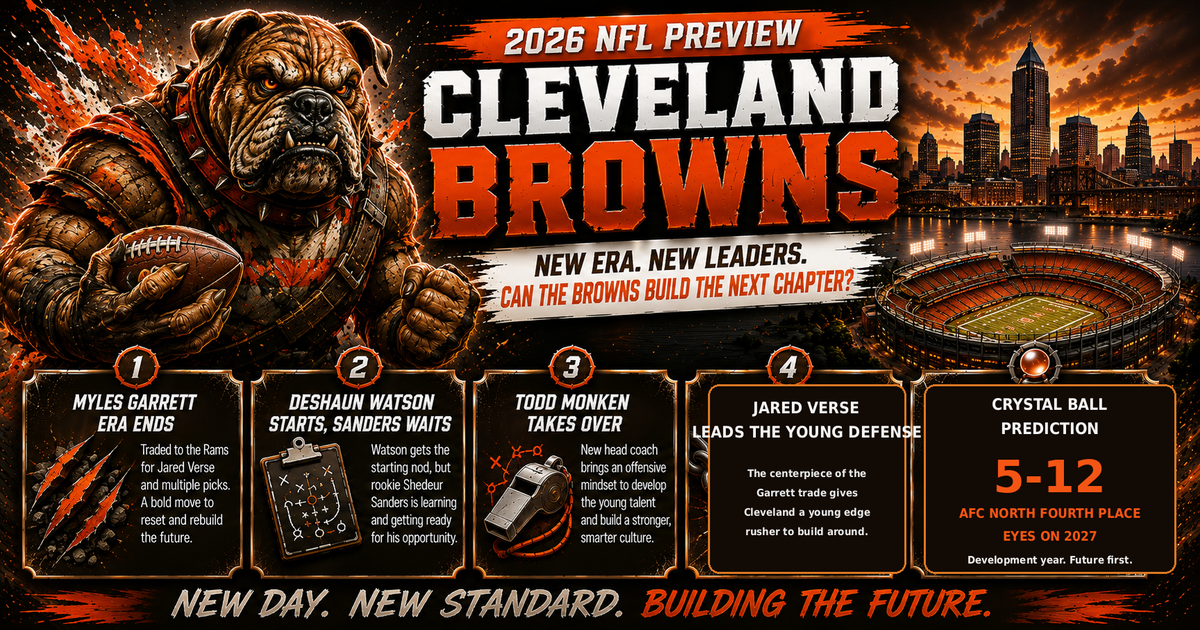
The Cleveland Browns traded away the best defensive player in football. They handed the starting quarterback job to a player who has not been the answer since his first year in Cleveland. They hired a new head coach. They are, by any honest measure, starting over.
This is not the worst position a franchise can be in. Starting over with intention -- with young talent arriving, with a coaching staff rebuilt around a clear vision, with a quarterback of the future waiting behind a veteran bridge -- is how rebuilds are supposed to work. The question for the 2026 Browns is not whether they win this year. It is whether the moves they made this offseason are the right foundation for what comes next.
Trading Myles Garrett is the most significant decision this franchise has made in a decade, and everything about how Cleveland performs in 2026 will be evaluated through that lens. Whether the Garrett era ended the right way, whether the return was worth it, whether Todd Monken's debut can build something real in a locker room that has been through four head coaches in eight years -- those are the questions that make Cleveland one of the most interesting stories in the AFC North this fall, even if the win total does not reflect it.
The Garrett Trade and What It Means
On June 1, the Browns traded Myles Garrett to the Los Angeles Rams.
That sentence deserves a moment. Garrett was not just the best player on this roster. He was one of the best defensive players in football, arguably the best pure pass rusher in the game. He recorded 23 sacks in 2025 -- an NFL single-season record -- and was named PFWA Defensive Player of the Year. He was 30 years old. He had at least three or four more elite seasons in front of him.
Cleveland received Jared Verse, a 2027 first-round pick, a 2028 second-round pick, and a conditional 2029 third-round pick in return, with that final pick reportedly becoming a first-rounder if the Rams ever trade Garrett to an AFC North team.
The haul is significant. Verse was the NFL's Defensive Rookie of the Year in 2024 and gives the Browns a legitimate young edge rusher to build around. The picks give a rebuilding team future ammunition. The football logic of the trade is defensible -- when a franchise is rebuilding and its best player is 30, moving him for a younger version plus capital is the kind of move that can define a rebuild's success three or four years from now.
But Garrett was also a face. He was the player the fanbase connected with, the one who made losing seasons watchable, the one who showed up every week with his helmet and his fury regardless of what the scoreboard said at the end. Trading him away in the middle of a rebuild sends a message: the front office is not interested in papering over dysfunction with a superstar pass rusher. They want to build something real, and they were willing to pay the short-term cost of doing it without their best player.
Whether that turns out to be the right call gets answered in 2028 or 2029, not 2026.
Deshaun Watson Is the Starter. Shedeur Sanders Is Watching.
On August 24, the Browns named Deshaun Watson their starting quarterback for the 2026 season.
That announcement came with a caveat that every Cleveland fan already knows: Watson has not been the player the Browns paid for since the 2022 season. A torn Achilles in 2024, a January 2025 re-tear that cost him the entire 2025 season, and years of uneven play before that -- the list of reasons to move on from Watson is as long as the contract that still ties him to the organization. The Browns are not starting Watson because they believe in him unconditionally. They are starting Watson because he is a veteran, because he gives the offense some experience, and because Shedeur Sanders is still developing as a second-year quarterback.
Sanders was the fifth-round pick who became the loudest story of Cleveland's 2025 draft class, arriving as one of the most scrutinized quarterbacks to enter the league in years. His father Deion Sanders is one of the most recognizable figures in American sports. His college career at Colorado was dissected by every analyst, every front office, and every fan who had a draft opinion. He came into camp with enormous expectations and a level of attention that would have overwhelmed most players his age.
He handled it. By all accounts, Sanders impressed in camp. He is quick with the ball, accurate in the short and intermediate game, and comfortable in the pocket for a young quarterback. He did not win the starting job outright, but the manner in which he competed suggests he is closer to NFL-ready than the final decision indicated.
The honest question is not whether Watson or Sanders should start in Week 1. It is how long Watson keeps the job if he struggles. This is a team with no real incentive to protect a veteran at the expense of developing its franchise quarterback. If Watson hits a rough stretch -- and his injury history suggests he will face some adversity -- Monken will not have a compelling reason to keep him on the field while Sanders watches from the sideline.
Watson is the starter. Sanders is the future. The gap between those two sentences may close faster than anyone in Cleveland is publicly acknowledging.
Todd Monken Inherits the Project
Todd Monken takes over as head coach after the Browns fired Kevin Stefanski following a 5-12 season. Monken coordinated Georgia's back-to-back national title offenses from 2020-22, then spent 2023-25 running Baltimore's Lamar Jackson-led offense before returning to Cleveland. This is his first head coaching job at the NFL level.
The timing is interesting. Monken is an offensive mind taking over an offense that is quarterbacked by a player trying to justify his contract with a roster that is in rebuild mode. That is a lot of context for a first-year head coach to navigate, and the learning curve of running a full NFL operation -- personnel decisions, roster management, locker room culture, the day-to-day operation of a franchise -- is steeper than even experienced coordinators typically expect.
What Monken brings is a clear offensive philosophy. His best offenses at Georgia and Baltimore were sophisticated, creative, and built around marrying the run game with precision route running and quarterback accuracy. If Sanders develops the way the Browns hope, Monken's system is the kind of structure that gives a young quarterback room to grow without asking him to improvise his way through complexity. If Watson holds the job through midseason, Monken's challenge is adapting that system to a quarterback whose physical limitations are more pronounced than they were three years ago.
Offensive coordinator Travis Switzer followed Monken from Baltimore and gives Cleveland a run-game voice who understands the system Monken wants to build. Defensive coordinator Mike Rutenberg takes over the other side of the ball, which means the defense is not just replacing Garrett -- it is also learning a new leadership structure at the same time.
Jared Verse and the Young Defense
The best thing about the 2026 Cleveland Browns defense is that it is young and it has real talent, even without Garrett on the edge.
Jared Verse arrives from Los Angeles as the centerpiece of the Garrett trade return. He was the league's Defensive Rookie of the Year in 2024, a 260-pound edge rusher with explosive first steps and the ability to win with both speed and power. He is 25 years old. He gives Cleveland a genuine building block at the position that Garrett vacated, even if replacing what Garrett was doing statistically last season is not realistic in Year 1.
Carson Schwesinger was the NFL's Defensive Rookie of the Year at linebacker in 2025, giving Cleveland the rare pairing of the last two AP Defensive Rookies of the Year on the same roster. He is already one of the better young linebackers in the conference -- instinctive, physical, and reliable against both the run and the pass. At 22, he is the kind of player who can anchor a defense for the next decade.
Denzel Ward remains one of the better cornerbacks in the AFC when healthy. Health has always been the caveat with Ward, but when he is on the field in a defense that protects its corners with enough safety help, he is a legitimate shutdown piece.
The challenge is that building around Verse, Schwesinger, and Ward takes time. It also got harder when Alex Wright suffered a season-ending Achilles injury in camp, forcing Cleveland to sign Derek Barnett and likely lean more heavily on Isaiah McGuire opposite Verse. The 2026 season is likely a developmental year for the defense -- Rutenberg can keep the unit competitive and disciplined, but expecting the Browns to be a top-10 defense while replacing the most dominant pass rusher in the league is not a realistic ask.
The Offense Has Young Pieces
The most important non-quarterback piece is Quinshon Judkins, the second-year back who gives Monken and Switzer the physical runner they need to build a real early-down identity. If Cleveland is going to protect Watson, develop Sanders, and keep games manageable, Judkins has to be more than a volume back. He has to be the player who makes the Browns offense functional before the quarterback is asked to solve everything.
Jerry Jeudy remains the veteran receiver who can win routes and keep the passing game on schedule. Rookie receivers KC Concepcion and Denzel Boston add speed, youth, and upside to a room that needed it badly, while Harold Fannin Jr. gives the offense a young tight end who can grow with whichever quarterback eventually becomes the long-term answer.
This is not a finished offense. But it has enough young pieces to evaluate, and that matters in a season where development is more important than chasing a wild-card spot.
What a Successful Season Looks Like
The Browns are not winning the AFC North in 2026. Baltimore has Lamar Jackson healthy, Cincinnati has Burrow and Dexter Lawrence, and Pittsburgh has Aaron Rodgers in his final season with Mike McCarthy scheming for him. Cleveland is the fourth team in a four-team division race and will finish that way.
But a successful season is not defined by a win total in a rebuild year. It is defined by what gets answered.
Does Watson hold up physically and give the offense enough to evaluate what Monken's system can produce? Does Sanders develop in practice and in situational play well enough to confirm that Cleveland has something worth developing? Does Verse establish himself as a legitimate starting edge rusher in Year 3? Does Rutenberg's defense stay disciplined and competitive even without Garrett generating pressure?
Those are the real scorecard items for Cleveland in 2026. The teams that rebuild well ask these questions clearly and answer them honestly. The teams that rebuild poorly pretend to compete when they should be developing. Monken and the front office seem clear-eyed about where this team is -- naming Watson the starter without committing to him as the long-term answer is exactly the kind of honest evaluation a rebuild requires.
Crystal Ball Prediction
Win total: 5-12. AFC North fourth place. Eyes on 2027.
Five wins matches last year's output and is the honest projection for a team this deep into a rebuild, in this division, with these questions at quarterback. The Browns will win some games they should not. They will lose some they could have had. That is what 5-12 teams do.
But 2026 is not about wins. It is about Watson giving Monken enough data to make the Sanders decision with confidence. It is about Verse reminding the league why the Browns wanted him in the Garrett deal. It is about Rutenberg keeping the defense respectable while the roster comes together. It is about Shedeur Sanders watching, learning, and waiting for his moment.
The moment is coming. It just might not arrive until 2027.
Make your NFL picks at Crystal Ball Picks.