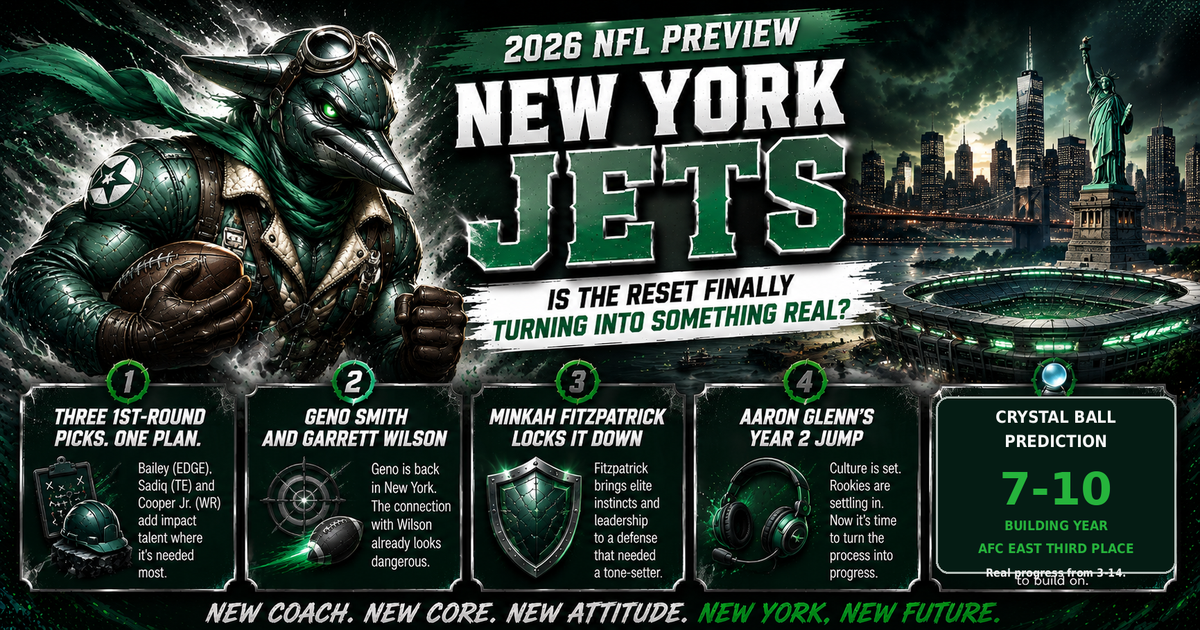
The New York Jets went 3-14 last year. They released Aaron Rodgers before the season started, watched their offense fall apart without a functional quarterback, and finished 31st in scoring defense. It was a year that felt like the franchise had finally hit the reset button it had been avoiding for years -- loudly, and not by choice.
Then they did something the Jets almost never do.
They made a plan. And so far, it looks like a real one.
General manager Darren Mougey spent the offseason making aggressive, structured moves: three first-round picks in the same draft, a veteran quarterback who actually fits the offensive coordinator's system, and two proven defensive veterans who change the communication and character of the back half of the roster. It is the most coherent offseason the Jets have had in years. Whether they can execute on it -- whether this team can actually become what the offseason suggests it might be -- is the question that separates the Jets' past from whatever they are trying to build next.
Three First-Round Picks, One Clear Message
The Jets entered the 2026 NFL Draft holding the second overall pick, and they used it the right way.
David Bailey, the Texas Tech edge rusher, was the class's most feared pass rusher and the obvious selection. Bailey shared the FBS lead with 14.5 sacks and added 19.5 tackles for loss in 2025. His explosiveness, bend, and get-off project him as an immediate starter. The Jets finished last season with just 26 sacks -- a number that explains most of what went wrong on defense -- and Bailey is the first legitimate answer to a pass-rush problem that has plagued this roster for years.
With the 16th pick, New York selected Kenyon Sadiq, the Oregon tight end who ran a 4.39 40-yard dash and took most of his 2025 snaps from the slot as a matchup nightmare. Sadiq is a chess piece -- the kind of versatile receiving tight end who forces defensive coordinators to account for an extra receiver at a position that is usually a blocking afterthought. Garrett Wilson finally has a weapon next to him rather than a collection of roster fillers.
Trading back into the first round at 30, the Jets grabbed Omar Cooper Jr., the Indiana receiver who caught 13 touchdowns in 2025 and forced 27 missed tackles after the catch. He is compact, strong, and dynamic in the slot, the kind of player who turns short passes into extended gains and gives a quarterback an easy answer on third down.
Three first-round picks. An edge rusher, a tight end, and a slot receiver. Each one addresses a specific gap on this roster. The draft logic is unusually clean for a franchise that has often made picks based on desperation rather than design.
Geno Smith and the Garrett Wilson Connection
The quarterback situation is the honest caveat in every positive sentence written about the 2026 Jets.
Geno Smith is back in New York, signing with the franchise that originally drafted him more than a decade ago. His last stop -- Las Vegas -- ended with him leading the league in interceptions, which is not a credential that builds confidence in a quarterback's ability to protect the football.
But Frank Reich, the Jets' new offensive coordinator, has been enthusiastic about what he sees in camp. Smith's connection with Garrett Wilson has been one of the more consistent storylines out of Florham Park -- five catches on five targets in one practice session, no balls hitting the ground, Wilson moving in and out of different alignments and finding open grass against coverage that should have been good enough to contain him.
Wilson has been one of the most underused stars in the AFC for three years. He has had to survive an Aaron Rodgers who was never healthy, an offensive line that could not create time, and a receiver room that offered him no real help. Now he has Sadiq in the seam, Cooper in the slot, Breece Hall out of the backfield, and an offensive coordinator who understands how to build a structure around a receiver's strengths rather than asking him to overcome an offense's weaknesses.
If Smith manages the game -- limits the turnovers, gets the ball out on time, takes the underneath throws Reich is designing for him -- this offense can function. It does not need to be elite. It needs to be competent enough for the defense to win games.
That is a reasonable ask. Whether Smith can deliver it consistently, against real defenses, in cold November games, is the question the regular season will answer. The Raiders tape suggests concern. The camp tape suggests something more encouraging.
Minkah Fitzpatrick Changes the Defense
The most underrated addition to the Jets' roster is not Bailey. It is Minkah Fitzpatrick.
The Dolphins traded Fitzpatrick for a seventh-round pick as part of their full roster teardown, and the Jets signed him to a three-year, $40 million deal while reuniting him with defensive coordinator Brian Duker. That is extraordinary value for a player who gives the back end of Aaron Glenn's defense something it has not had in nearly a decade: a legitimate All-Pro safety who can communicate, diagnose, and clean up mistakes before they become touchdowns.
Glenn's 4-3 scheme is built on aggressive man coverage and front-four pressure. Both of those concepts only work when the safety behind them is trusted to be in the right place before the ball snaps. Fitzpatrick is exactly that safety. He was a back-end organizer during his long Pittsburgh run and again during his Miami return, and his arrival gives the Jets' young corners a voice behind them who can correct alignment, set eyes, and make the coverage work in a way it never has here.
Demario Davis returned for his third Jets stint on a two-year, $22 million deal to anchor the linebacker room, bringing 143 tackles from last season in New Orleans and a veteran presence that the Jets desperately needed in the middle of their defense. At 37, Davis is not the player he once was, but he is still the player who understands the game at a level that makes everyone around him better.
Joseph Ossai and Kingsley Enagbare give Bailey rotational help at edge. David Onyemata anchors the interior. Glenn's pass-rush plan is no longer built around wishful thinking. It is built around Bailey generating havoc and a surrounding cast that can hold up long enough for him to do it.
Aaron Glenn's Year Two Test
Aaron Glenn is on the hot seat. After a 3-14 first season, it could not be otherwise. But the circumstances of that 3-14 season matter. The Jets had no functional quarterback, one of the worst defenses in the league, and a roster that had been built around Aaron Rodgers' needs rather than around a coherent team philosophy.
What Glenn has now is different. Mougey addressed the roster. Frank Reich addressed the offense. Glenn gets to be a head coach with something to work with rather than a head coach managing a rebuild with no infrastructure.
His track record as a defensive mind in Detroit -- the Lions' defense under Glenn's coordination was one of the more improved units in the league before he left -- suggests he can build something here. Whether he can manage the full operation of a franchise, handle the New York media, and translate defensive competence into wins in a division with Buffalo and New England above him in the standings, those are questions Year Two has to begin answering.
The hot seat framing is fair. Glenn deserved the chance to coach a real roster before anyone judged him. He has one now.
The Jets Are Still the Jets (For Now)
The AFC East is not going to be kind to New York in 2026. The Bills have Josh Allen and an open window. The Patriots have Drake Maye and A.J. Brown. Even the Dolphins, though fully rebuilding, are going through a legitimate reset with a coherent plan.
The Jets are not catching the Bills this year. They are not catching the Patriots either. But the gap between New York and the rest of the division is smaller than it was twelve months ago, and the trajectory of this roster is pointing in a direction it has not pointed for a long time.
Bailey will face double teams. Smith will have bad games. The offensive line will have weeks where it cannot hold up. The secondary is still inexperienced outside of Fitzpatrick and has to learn Glenn's system on the fly against real offenses. None of this is smooth.
But it is a building year with a foundation under it. That is not something the Jets have been able to say in a while.
Crystal Ball Prediction
Win total: 7-10. Building year, AFC East third place.
Seven wins is real progress from 3-14. It is also an honest assessment of where this roster is relative to Buffalo and New England in the same division. The offense has more weapons than it has had in years, but Geno Smith is not a quarterback who wins you games on talent alone. The defense has more pieces, but Bailey is a rookie and Fitzpatrick cannot fix everything.
What success looks like for the Jets in 2026 is not a playoff berth. It is Garrett Wilson finally being unleashed on an offense designed around him. It is Bailey emerging as the legitimate pass rusher the franchise has needed for years. It is Geno Smith surprising people who wrote him off after Las Vegas. And it is Aaron Glenn proving that 3-14 was the floor, not the ceiling.
The Jets have a plan. They have the pieces. Whether they can execute -- that has always been the question. For once, they deserve the chance to find out.
Make your NFL picks at Crystal Ball Picks.